



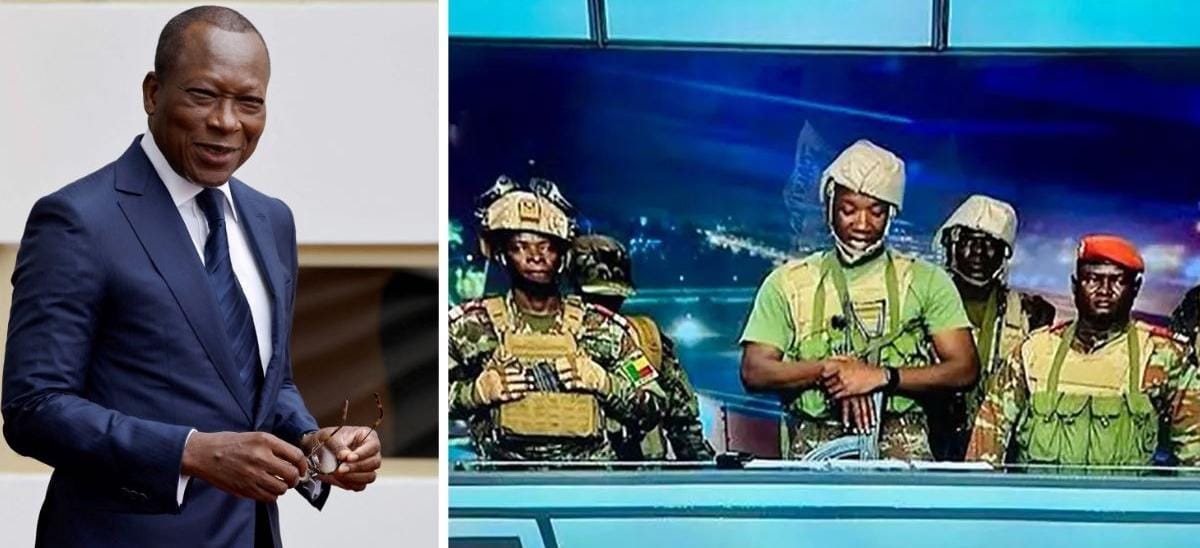

By Sunday night (7 December), Benin citizens were still expecting to hear from their President, Patrice Talon, after what his government described as a mutiny by some soldiers or a failed coup earlier in the day.
Diplomatic sources said Talon was “under high security protection” in the French Embassy compound in Cotonou, the nation’s capital. Residents said the area had been cordoned off under a heavy security presence.
At least two Nigerian Air Force fighter jets were seen over Cotonou airspace on Sunday, believed to have assisted the Benin armed forces in dislodging the mutineers.
A group of eight soldiers led by Lt.-Col Pascal Tigri had appeared on national television to announce that they had toppled the Talon government.
Their intermittent announcements later ceased before Foreign Minister Olusegun Adjadi Bakari and other government officials said via trending videos that President Talon was “safe” and that the attempted coup had been foiled. The government officials said loyal troops had taken over control, with some of the mutineers arrested, while others were on the run.
Among their reasons for the attempted coup or mutiny, the Tigri-led soldiers cited “neglect of fallen colleagues and their families,” a reference to casualties in the fight against jihadists.
They also mentioned “cuts in health care and tax rises, as well as curbs on political activities.”
The group had ordered the suspension of the constitution and closure of all the country’s borders, promising peace and stability, and assuring the international community that it would respect all treaties and obligations.
Benin planned parliamentary elections in January 2026 to be followed by a Presidential poll in April. Talon, who has ruled Benin with an iron hand for 10 years, said he would not run for a third term, throwing his weight behind a favourite candidate. Several of his political opponents are either in jail or in exile abroad.
In January, two of his associates were sentenced to 20 years in prison for an alleged 2024 coup plot. Last month, the country’s legislature extended the presidential term of office from five to seven years, keeping the term limit at two.
Benin shares borders with the West African regional power, Nigeria.
The attempted putsch in Benin, which has been condemned by the Economic Community of West African States (ECOWAS) the African Union and the Nigerian government, comes on the heels of the strange army takeover of government in Guinea-Bissau.
Critics and President Umaro Sissoco Embaló’s opponents accuse him of masterminding the coup to stop an electoral process after sensing he would lose the 23 November presidential poll.
Embaló announced the coup himself, on 26th November, a day before the electoral Commission had planned to announce the provisional results of the elections. Among the coup leaders and the 28-member cabinet are his close allies.
Already, five of ECOWAS’ 15 member States are now ruled by the military, after military coups in Mali, Burkina Faso, Niger, Guinea and recently Guinea-Bissau.
Mali, Burkina Faso and Niger have quit the regional organisation to form the Alliance of Sahel States, AES.
Paul Ejime is a Media/Communications Specialist and Global Affairs Analyst