



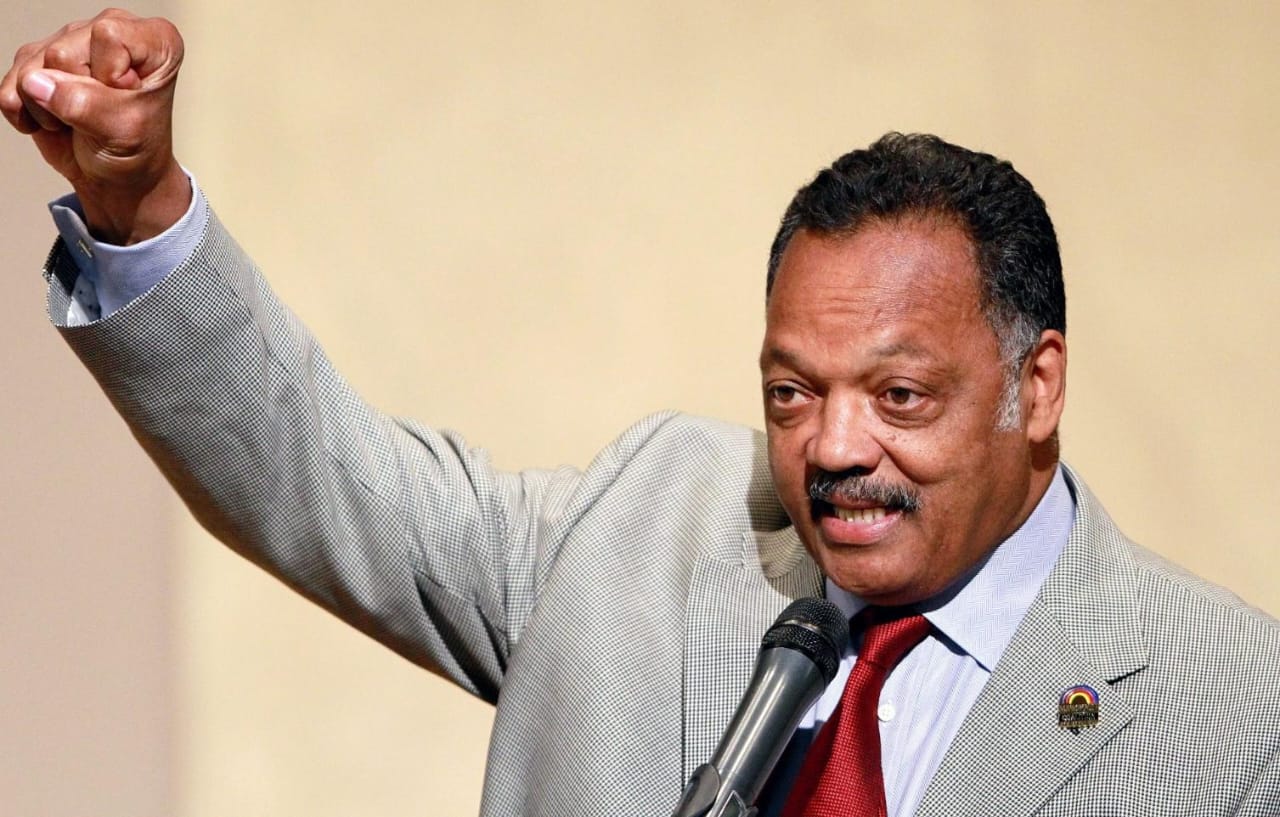

The life of the Rev. Jesse Louis Jackson Sr. (October 8, 1941 – February 17, 2026) was a landmark transition in African American political history that signposted the political coming of age of Blacks in America. He was also a bridge builder to Africa.
Flamboyant Jesse Jackson walked the American political terrain like a triumphant colossus. He confounded the racist political establishment when he emphatically stamped his status as a credible presidential candidate with his stunning defeat of other presidential contestants in the Michigan State Democratic Party primary on March 26, 1988. In that historic victory, where he got 55% of the vote in a crowded field, Jesse had, defeated among others, front runner Governor Michael Dukakis of Massachusetts, Sen. Al Gore, Sen. Paul Simon, Bruce Babbitt, former Arizona governor and Congressman Dick Gephardt, then-House Majority Leader in a State with about 75 percent White population.
On the major television networks – ABC, CBS and NBC – the night of March 26, was saturation coverage of Jesse’s shock victory. America’s mainstream newspapers were also bowled over. The New York Times, Washington Post, and the Los Angeles Times, which had treated Jesse as a fringe candidate, woke up to a new reality after Michigan, acknowledged the ‘’historic breakthrough,’’ the ‘stunning win,’’ with accompanying narrative that “American politics will never be the same again.”
W. Apple Jr., a top American journalist, writing in The New York Times on April 29th 1988, had, after the historic Michigan victory, predicted: ‘’Jackson is seen as winning a solid place in history.” By the end of the 1988 Democratic presidential primary race, it was only Jesse Jackson and front-runner Michael Dukakis standing, with Jesse having garnered 6.9 million votes and secured over 1,200 delegates, an unprecedented achievement for someone earlier dismissed as a joke!
Jesse was phenomenal on the campaign trail, mesmerizing and galvanizing audiences with his oratorical eloquence. Campaign stops were like pulpits to the Baptist Minister for political ecumenical exhortation on his campaign slogan: Keep Hope Alive.
Jesse built a political Rainbow Coalition across race, religion, ethnicity and class, which gave his campaign momentum, and drawing mammoth crowds. At one of his campaign rallies in Washington D.C., I took along my then-four-year-old son, Dapo, now a father of three. The boy had observed an ambulance parked strategically at the rally ground and, apparently out of curiosity, asked: Daddy, why is there an ambulance at the rally? I explained that it was to respond to any emergency, due to gun violence associated with American politics, as underscored by the attempt on candidate Donald Trump’s life at his campaign rally in Butler, Pennsylvania on July 13, 2024.
On January 19, 2009, a day before Barack Obama’s inauguration as American President, following his election in 2008, I penned an article on my weekly BISIBEE Column in the People’s Daily, an Abuja-based newspaper, captioned: Triumph of Hope: From Jackson 88 to Obama 2008 – The March of Black America. Jesse Jackson was the political John the Baptist, who heralded the coming of President Obama.
Jesse built bridges to Nigeria and Africa with his several visits to the continent. In recognition of his pro-Africa stand, President Bill Clinton appointed him Special Envoy for the Promotion of Democracy in Africa in 1997.
Sadly, Obama, who was born to a Kenyan father in the U.S., not only collapsed the bridge built by Jesse Jackson, he turned out a tragedy for Africa with his presidency’s support for the Arab Spring of 2011 that devastated Libya and got its leader, Muammar Gaddafi, killed. Obama also endorsed the toppling of the democratically elected Egyptian government of President Mohamed Morsi of the Muslim Brotherhood in a military coup by Gen. Abdul Fattah Al-Sisi in 2013. Gen. Al-Sisi later transmuted into a civilian president and has remained in power till date.
Obama was not done with Africa. He tried to intimidate African governments into accepting same-sex marriage, a move stoutly rebuffed by African leaders, including President Goodluck Jonathan of Nigeria and President Yoweri Museveni of Uganda. Jesse wept at Obama’s inauguration, perhaps prescient of the disaster Obama would become to Africa that he (Jesse) laboured to engage.
A milestone engagement of Rev. Jesse Jackson with Africa was his central role in the anti-apartheid struggle, particularly the year-long protest marches on the South African Embassy in Washington, D.C.. I covered those marches, even in chilly winter months, with protesters rhythmically chanting: Freedom Yes, Apartheid NO. Jesse Jackson took centre spot, often flanked by other dignitaries, including Randall Robinson, founder of TransAfrica Forum, D.C Delegate Walter Fauntroy and Washington D.C. Mayor, Marion Barry. Jesse’s presence electrified the mass protests and attracted massive media coverage, bringing the immorality of the apartheid system to American living rooms, and creating a groundswell of support. It was a measure of the huge success of the anti-apartheid protests and other lobbying efforts that the U.S. Congress voted to override President Ronald Reagan’s veto of the Anti-Apartheid law that imposed economic sanctions on the South African government. The House of Representatives had on September 29, 1986 voted 313-83 to override Reagan’s veto and the Senate did the same on October 2, 1986 with 78-21 votes, allowing the sanctions to take effect in spite of the president’s objection. It was a landmark event, being the first time in the 20th century that a President’s veto on foreign policy was overturned by Congress.
Since my arrival in Washington D.C. in July 1985 as a foreign correspondent, I had reported Jesse Jackson largely from a distance. I met him for the first time on August 6, 1986 in Chicago at the McCormick hotel, venue of the 1986 Operation PUSH Convention. PUSH – People United to Serve Humanity was founded by Jesse Jackson in 1971 as a non-profit platform for economic empowerment, expansion of educational, business and employment opportunities for the disadvantaged and people of colour, especially African Americans.
At that time, Jesse, as he was affectionately called, was the biggest African American name in politics and a most charismatic and eloquent politician. He had ran for the presidential ticket of the Democratic Party in 1984, but with limited impact then. Lanky and standing at 6.3ft, Jesse had a commanding presence. He walked with a swagger, and once humorously quipped that with his height, “some people still wanted him to walk like a dwarf.”
Due to his tight schedules our planned interview could not hold. He then suggested that I flew back with him to D.C.on August 7, 1986, for the interview to be held in-flight.
The interview was conducted as agreed, but in a start-and-stop manner, with a tired Jesse often dosing off mid sentence.
Jesse lived a full life and left a legacy of political, economic, ethnic and religious accommodation, anchored on his mantra of keeping hope alive for a better and inclusive America, which he espoused, most profoundly, at the 1988 Democratic Convention in Atlanta, Georgia. I watched the proceedings, live, on TV from Washington. Jesse gave a virtuoso performance with his evocative, masterclass delivery on his slogan: Keep Hope Alive, drawing tears not only from delegates at the Convention, but across America.
‘’You can make it, I was born in a slum, those of you listening to me tonight in the Projects, and wherever you are tonight, you can make it,’’he said.
The Rev. Jesse Louis Jackson Sr., whose funeral service held at House of Hope in Chicago on March 6, 2026, was for over forty years, one of America’s foremost civil rights, religious and political figures and a leading crusader for social justice. In affirmation of his pivotal role in America’s public life, he was awarded the Presidential Medal of Freedom, America’s highest civilian honour, on August 9, 2000.
Dr. Bisi Olawunmi, former Washington Correspondent of the News Agency of Nigeria (NAN) is Associate Professor, Adeleke University, Ede. Osun State. Email: olawunmibisi@yahoo.com: bisi.olawunmi@adelekeuniversity.edu.ng Phone (SMS only): +234803 364 7571.