




First responders have had their field day of reactions immediately after Daniel Bwala, Special Adviser on media and policy communication to President Bola Ahmed Tinubu, literally got roasted during a public affairs programme on Al Jazeera, a global television station.
Bwala has been in ruminative quietude since the hit he suffered on March 6, 2026 day in London. He journeyed ahead of President Bola Ahmed Tinubu’s State Visit to the United Kingdom as a guest of King Charles as part of the build-up to the historic event. For Bwala, it was to be a great opportunity to bask in global limelight, which could translate to a bigger appointment on a triumphant return home. But this was not to be, at least, for now, because the ever generous Godfather at Aso Rock may still reward Bwala with a higher appointment.
Now, let us begin with three posers: Who suggested and promoted fielding Bwala for that strategic engagement? What was Bwala’s understanding of the assignment? How well was he prepared for it?
Loudmouths and talking heads have, over time, seized Nigeria’s political public space, with the connivance of the media, such that they not only get away with outrageous false claims but also get handsomely rewarded. And this reinforces their sense of value and self-importance, as they got sought or they sought and got accommodated on prime time TV and radio interview programmes. The more controversial, the more attractive for programme anchors and hosts, especially for television with its powerful combination of sight and sound, which allows posturing. Sources and journalists are engaged in the synthetic manufacture of news!
So, except for Bwala’s ability to attract media attention for his controversial statements and posturing, what other criteria recommended him to be the face of Nigeria’s public governance before the world? What are his antecedents, apart from being a political maverick? Those who suggested and/or approved Bwala for that role should share in the blame for his poor outing. Given his apparent inadequacy for that role as a former Tinubu denigrator, it could also be a setup for a big fall.
As to Bwala’s understanding of the assignment, he probably took it as a joy ride, a bask in the sun. Had he not dominated the national publicity space in the country? Ebullient, charismatic Danny Boy, looking so well fed and apparently primed himself for a showmanship performance on Al Jazeera. After all, TV generally projects more as an entertainment platform.
But information management is a serious matter – strategic and calculative. It requires ability at critical thinking, analytical perspectives and sharp reflexes to logically deflect attacks.
A brief critique of the interview should provide context. (apology to Bwala). The odds were stacked against him as he went ‘Head to Head’ with anchor Mehdi Hasan. The title of the encounter – Nigeria: ‘ Renewed Hope’ or ‘Hopelessness’ is suggestive of a combative engagement, which should have put Bwala on the alert. But he was apparently blinded by overeagerness for the privilege of being the point man for the big sell of President Tinubu to the world, to see the banana peel. How saleable is the product?
While Tinubu, as a product, cannot be dismissed as bad, viewed contextually, Bwala, the salesman, became a disaster because Mehdi Hasan deftly used his (Bwala’s) past words where he projected Tinubu as a tainted product, to destroy his credibility as a defender of that same unedifying product. For instance, on the issue of drugs, Bwala was quoted to have said that there was still a cloud over Tinubu in spite of judicial exoneration. Bwala was also reminded that on Feb. 17, 2023, he stated on Channels TV that two bullion vans, which drove into Tinubu’s Ikoyi residence on election eve, carried money ‘ ostensibly’ for vote buying. On Arise TV on March 2, 2023, he also said he couldn’t eat for three days following what he perceived as Tinubu’s undeserved victory at the polls. Hasan repeated these words of Bwala three times, apparently for emphasis.
When Bwala denied his own words spoken on TV, the audience at the interview session burst into laughter, while Bwala had a sheepish grin on his face. It was a relentless tackle by the anchor. The presidential spokesman was also confronted with his claim that Tinubu and his people set up a militia force to snatch the 2023 election and that they even threatened him (Bwala). He was also confronted by Hasan on his derisive query about Tinubu’s age.
Bwala responded that he said those things while in opposition! So, is being an opposition spokesman a licence for blatant lies and outrageous claims?
The issue of insecurity in Nigeria came up with statistics showing that more people were killed in 2025 than in 2024, both on Tinubu’s watch, indicating a worsening security situation. When Bwala dismissed the statistics on worsening insecurity as a matter of ‘context’, he drew another round of laughter from the audience.
However, in a manifestation of Bwala’s illogical disputation of worsening insecurity, he admitted that the government had to relocate thousands of students from schools in rural communities to the state capitals due to insecurity! On Tinubu’s claim that there is no more corruption in Nigeria, Bwala, again, said it was a matter of ‘context’.
There are three main types of interview – spot news interview, feature interview and public affairs interview, which sometimes double as issues or personality interviews, the type run by Mehdi Hasan on Al Jazeera TV. It is a source-media contrivance, which Prof. Daniel Boorstin defines as a pseudo-event, deliberately arranged between source and journalist to generate news or project a perception that would be of interest to the public. Journalists and sources seek each other out, with the initiative depending on who needs the publicity more. So, Herbert J. Gans describes the source-journalist relationship as ‘’resembling a dance,” a jolly-jolly affair.
Apparently, Bwala thought he was going for a dance of amity with Mehdi Hasan. But Gans also says that the source-journalist relationship can be ‘’a tug of war: where sources attempt to manage the news, putting the best light on themselves while journalists concurrently manage sources to extract the information they want.’’ This creates divergent goals for source and journalist, which Bwala, apparently, did not reckon with.
Perhaps, it was the Nigerian government that initiated the interview, on the assumption that it was going to be a public relations affair. That must be why Bwala, whose intent of a media jolly ride was torpedoed, decried the interview as an ambush by Mehdi Hasan, for focusing, unexpectedly, on his past statements about Tinubu.
That is an infantile defence, coming from a lawyer. It showed that Bwala was not well-prepared for the interview if he expected his past statements on Tinubu to be swept under the carpet. But for the irresistible allure of global exposure, he should have disqualified himself from that interview, given his antecedents.
No doubt, the Al Jazeera anchor was relentless in pinning down Bwala to his past words, to the presidential spokesman’s embarrassment.
An American distinguished journalist-cum-columnist, Carl T. Rowan, who later became U.S. Ambassador to Senegal, once posited: “There aren’t embarrassing questions – just embarrassing answers. It would, however, seem that Bwala has an ally in Dr Reuben Abati, an Arise TV host, who said Mehdi Hasan’s conduct in the interview was in bad faith, while his co-host, Rufai Oseni, countered that it was a matter of style.
Bad faith? Was Reuben privy to the terms of the presidency’s engagement with Al Jazeera, which Mehdi Hasan breached? Well, maybe it is a matter of Aso Rock fraternity, after all, Reuben was also at Aso Rock Villa as spokesman for the Goodluck Jonathan Presidency!
The Bwala misadventure on Al Jazeera was a national embarrassment for the country at the global level. Going forward, critical thinking must precede these critical decisions, and not be made a whimsical paddy-paddy affair. Information management is strategic, especially at the level of the presidency, and should not be given cavalier treatment. The prestige of a nation could be at stake. That interview was meant to be a persuasive, positive projection of President Tinubu and Nigeria to the world.
Greek philosopher Aristotle postulated three rhetorical pillars of persuasion – ethos (source credibility), logos (logic) and pathos (emotion) – used to influence the audience.
Bwala’s encounter with Mehdi Hasan on the ‘Head to Head’ programme destroyed his (Bwala’s) credibility as a person of integrity to persuasively promote President Tinubu’s image, the presidency and by extension, Nigeria.
One would like to ask – What’s next for Daniel Bwala? Given the negative exposure he suffered on that global TV platform, Bwala has not deemed it necessary, with his integrity deficit, to relinquish his position, and the presidency has not considered relieving him of his duties. It is a waiting game. However, with the much-touted legendary “large heart” of President Tinubu to accommodate and reward some abusers, Daniel Bwala may, in the spirit of the season, “resurrect” triumphantly, as an ambassador or minister. After all, this is Bola Tinubu’s Nigeria!
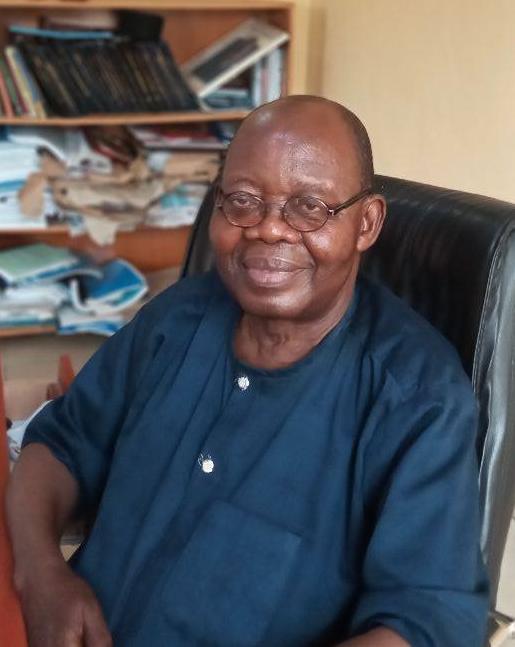
Dr Bisi Olawunmi, Associate Professor at Adeleke University, Ede, is a former Washington Correspondent of the News Agency of Nigeria (NAN) and Fellow, Nigerian Guild of Editors (FNGE). Phone 0803 364 7571 (SMS only)




