


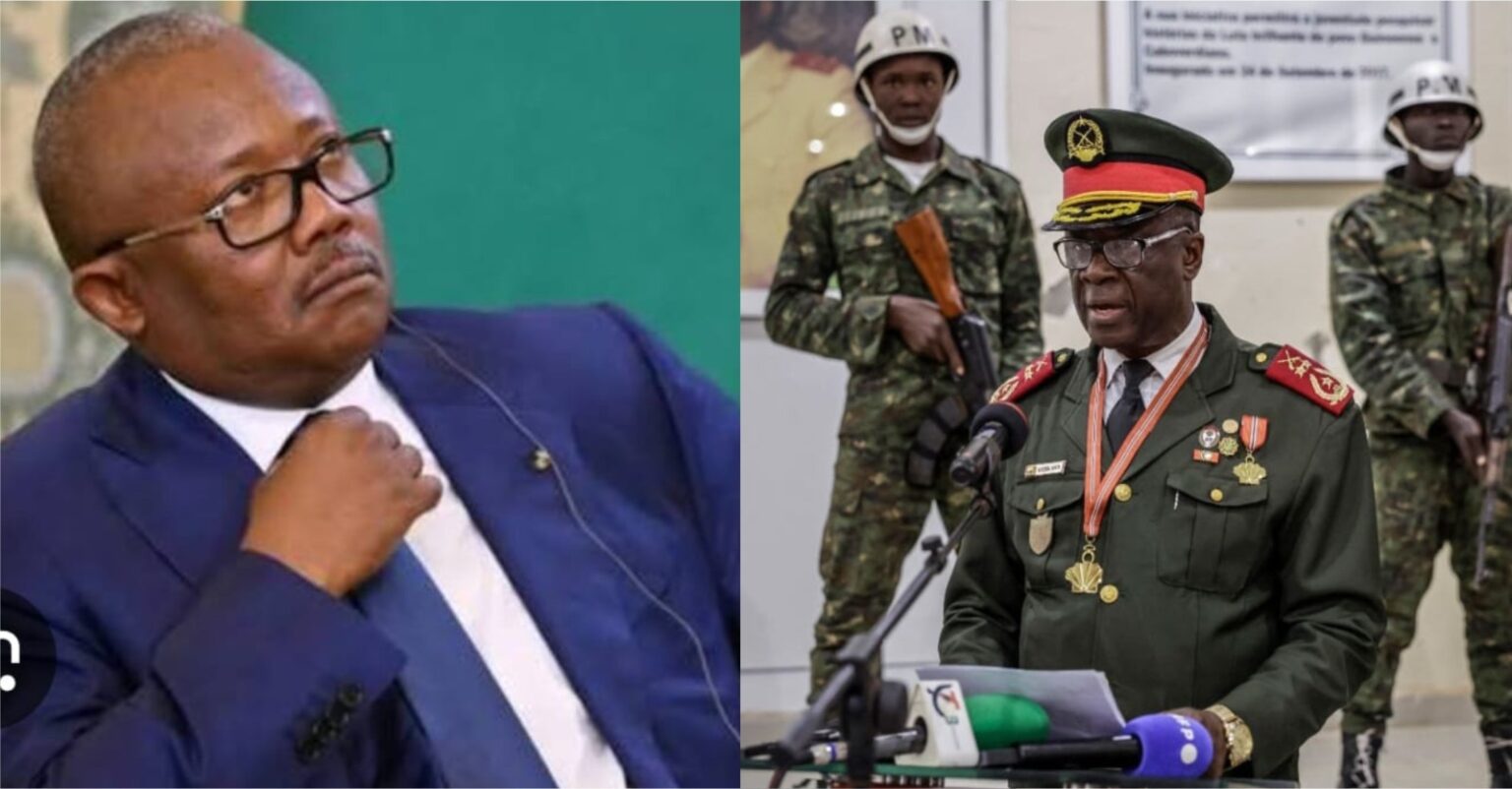

Umaro Mokhtar Sissoco Embaló, the 53-year-old former Prime Minister, teacher, soldier-politician and Guinea-Bissau’s 6th President, who called his style of governance “Embaloism,” has a dubious way with military coups, considered by many as suspicious, if not contrived. However, he appears to have overreached himself.
Guinea-Bissau, the country of Africa’s renowned nationalist Amilcar Cabral, with an estimated 2.2 million people comprising some 37 largely ungoverned islands, is not only poor, according to the United Nations Human Development Indicators, but is also notorious for hard drug trafficking and endemic political crises. Since parting ways with Cabo Verde and gaining political independence from Portugal in 1973, most leaders in Guinea-Bissau seldom complete their mandates.
Embaló’ is different. His original five-year mandate from February 2020, which he extended by almost one year, was characterized by constitutional conflicts, political instability, disruptions, and at least four reported attempted military coups, while opponents accused him of dictatorship.
The first two putsches in February 2022 and December 2023 resulted in the dissolution of the People’s National Assembly, or Parliament, manipulation of the judiciary, and the third, in October 2025, led to the arrest of senior military officers accused of trying to subvert the constitutional order. Some of the alleged coup suspects are still detained without trial.
The fourth reported coup attempt against the Embaló government, which he announced himself on 26 November, just as the National Electoral Commission planned to announce results of the 23 November General Elections, has been variously described as a “palace coup,” a “ceremonial/arranged coup” and “a sham.”
Senegalese Prime Minister Ousmane Sonko and Nigeria’s former President Goodluck Jonathan are among critics who doubt the authenticity of the latest coup, which suits a perfect description of “an African proverb of a thief who decided to hide his stolen items behind his back in the full glare of traders and clients at a market square.”
In March this year, Embaló threatened to expel a joint ECOWAS/UN fact-finding mission to Bissau for daring to meet with opposition figures and also prevented a Jonathan-led West African Elders’ Forum (WAEF) team from doing so.
Surprisingly, Embaló, in announcing the 26 November coup, also claimed that he was detained, while calling foreign media outlets to discuss his alleged ousting and detention.
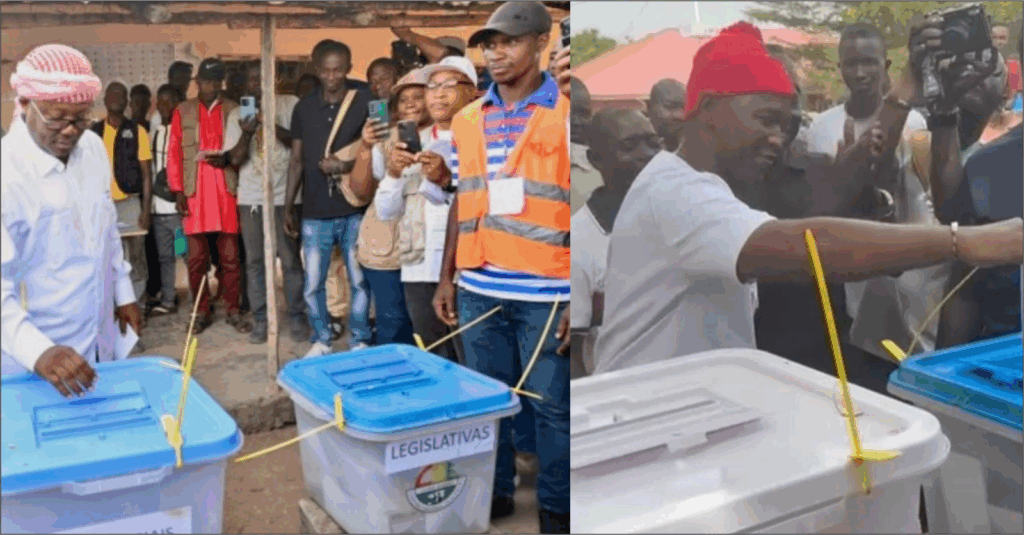
Embalo (now in Brazzaville) & independent Candidate Fernando Dias (now in hiding) casting their votes on 23 November in Bissau
Meanwhile, international observers, from ECOWAS, the African Union, the Community of Portuguese-Speaking Countries (CPLP), the g7+ of 20 conflict-affected countries, and the WAEF, described the 23 November legislative and presidential elections as peaceful and orderly, and were waiting for the announcement of the results on 27 November, when the soldiers struck.
There was sporadic gunfire near the Presidency with citizens running helter-skelter as the military invaded the CNE headquarters, arresting some of its officials and carting away sensitive documents and equipment.
Later, a group of military officers led by Gen. Denis N’Canha, the head of the Military Office at Embaló’s presidency, announced that the armed forces had seized power, citing an alleged attempt by “drug lords” to destabilize the country’s democratic process. The group ordered a halt to the electoral process, a night-dawn curfew and closure of the country’s airport and borders.
In the lead-up to the November poll, the Supreme Court of Justice disqualified the leader of the African Party for the Independence of Guinea-Bissau and Cabo Verde (PAIGC), Domingos Simoes Pereira and his opposition Coalition “PAI-Terra Ranka from contesting both the presidential and legislative elections. Pereira is now detained, and the Portuguese Community PCP and his family are calling for his release and the intervention of the international community.
The PAIGC fought for the independence of Guinea-Bissau and Cabo Verde, enjoying mass following in both countries. Embaló, who joined the party in 2016, left and resigned as Prime Minister to join the Madem G15 platform, on whose platform he contested and claimed presidential victory in 2019.
He was inaugurated in February 2020, and in the inconclusive 23 November vote, he and the independent candidate Fernando Dias, 47, claimed victory before the military took over power.
Dias is said to be in hiding within the Nigerian Embassy compound in Bissau, according to a statement by the Nigerian Foreign Ministry, which urged the President of the ECOWAS Commission to guarantee his safety.
Embaló’s Chief of Presidential Guards Gen. Horta Inta-A was inaugurated as Guinea-Bissau’s Transitional President on 27 November. He said he would govern for one year, and in a move to consolidate power, he has appointed another Embaló ally and Campaign Director, Ilídio Vieira Té, as the new Prime Minister and Finance Minister. He also named a 28-member cabinet.
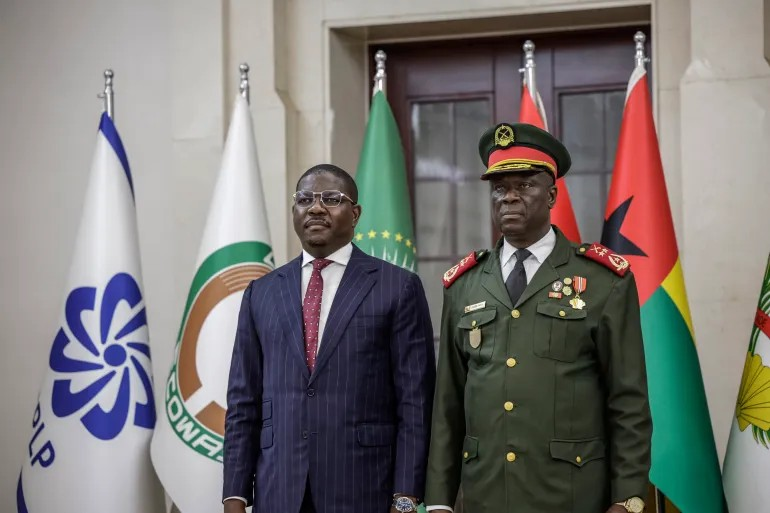
Gen. Inta-A with the new Prime Minister & Finance Minister Ilídio Vieira Té (R-L)
ECOWAS and the African Union have suspended Guinea-Bissau and threatened further sanctions over what they consider an illegal change of government, strongly condemned by the international community.
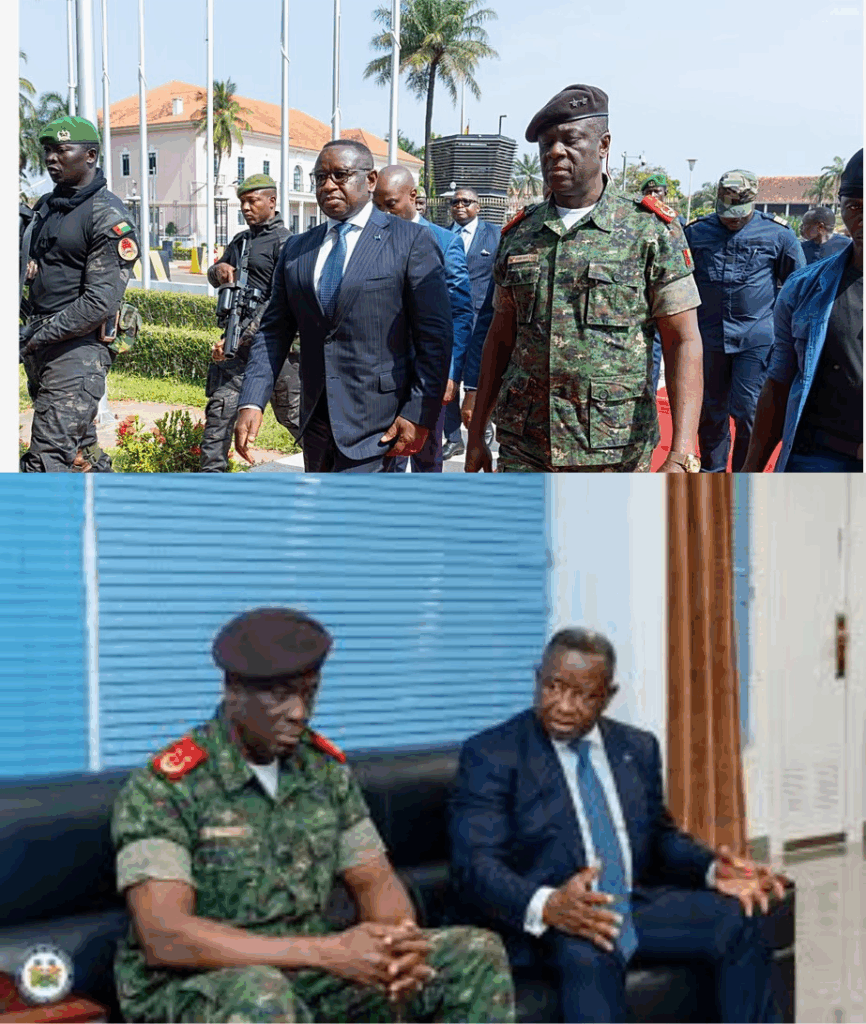
(R-L) The Sierra Leone President, Julius Maada Bio, who led the ECOWAS delegation, met with Gen. Inta-A & other military rulers
A high-level ECOWAS/UN delegation, led by the Chair of ECOWAS Authority, Sierra Leone’s President Julius Maada Bio, has visited Bissau for dialogue with the military rulers and insisted on the restoration of constitutional order. The delegation, which also met with released officials of the electoral commission, will submit its report to the ECOWAS summit scheduled to be held in Abuja on 14 December.
Embaló’, who prides himself as a “master strategist,” might have had his way as an authoritarian leader who could dissolve Parliament at will, manipulate the constitution and fill positions at the Supreme Court, which certifies the results of elections, with his loyalists.
However, it would appear that his luck has run out. He probably underestimated international reactions to his latest game plan. Critics believe he orchestrated the Phantom coup with his cronies to scuttle the electoral process because the results were not in his favour, with a possible plan to stage a comeback through a new election after an emergency rule.
Going by fillers from the ECOWAS extraordinary virtual summit, which decided on Guinea-Bissau’s suspension, most of the regional leaders have no appetite for “a staged military coup to disrupt an electoral process.”
Nigerian President Bola Tinubu is reported to be among regional leaders advocating hard-line measures against the Bissau coup makers, just as Embaló’ did in 2023 in his capacity as Chair of ECOWAS Authority against coup leaders in Mali, Burkina Faso and Niger, who later formed the Alliance of Sahel States, AES, and withdrew their countries from ECOWAS.
Senegalese President Diomaye Faye, who led the liberals calling for dialogue, which resulted in the compromise for high-level mediation, did not join the ECOWAS delegation to Bissau as promised.
Embaló’ has boxed himself into a very tight corner, with his chances of bouncing back highly improbable. President Faye has managed to evacuate him from Bissau to Senegal for refuge, but with Prime Minister Sonko against the idea, Embaló’ has now found his way to Congo Brazzaville.
To ECOWAS, the AU, and democracy lovers in Africa, the only redeeming option is to insist on the completion of the electoral process and the declaration of the winner without delay.
In the 2023 elections, Coalition PAI-Terra Ranka, which includes the PAIGC, won an absolute majority of 54 seats in the 102-seat parliament, whose membership is decided by proportional representation. The candidates or coalitions with a parliamentary majority appoint the Prime Minister, while a presidential candidate requires a 50%+1 vote to win; otherwise, the two front-runners go into a run-off poll after three weeks of the first balloting to determine the winner.
In the medium- or long-term, the operation of Guinea-Bissau’s semi-presidential system, under which the President shares political power with the Prime Minister and the Parliament, is problematic and must be reviewed for clarity, like what obtains in Cabo Verde, which operates a similar constitution.
Furthermore, the country’s endemically dangerous hard drug trafficking cancer-worm must be effectively addressed along with the long-overdue Security Sector Reform, to professionalize the armed forces and end its top-heavy structure with senior officers almost outnumbering the rank and file. The 2016 Conakry Accord to end the political crisis in Guinea-Bissau should be implemented.
Equally, the mandates of the ECOWAS Stabilization Support Mission in Guinea-Bissau (ESSMGB) and its counterpart in The Gambia must be reviewed to clarify that the Missions are to protect governance institutions, not individuals.
Paul Ejime, a Media/Communications Specialist and Global Affairs Analyst, was in Guinea-Bissau during the military takeover