


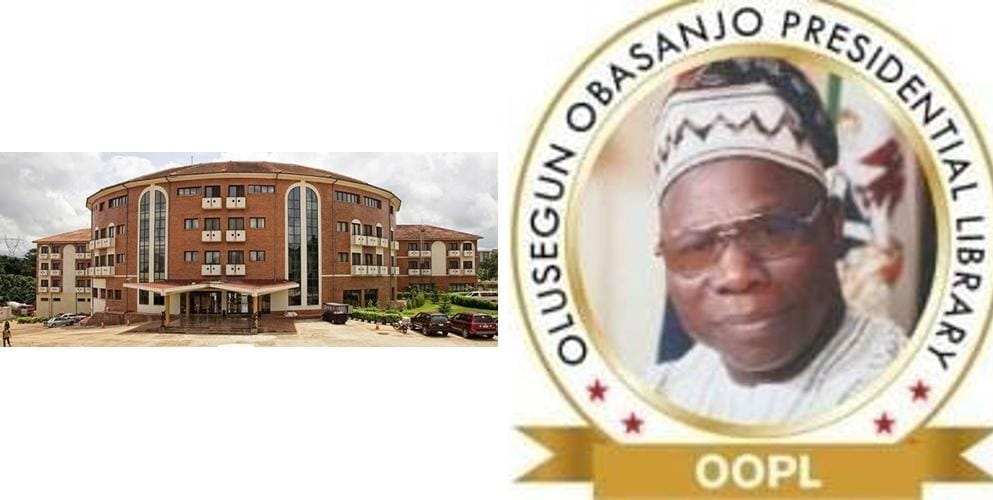

When visiting the Olusegun Obasanjo Presidential Library in Abeokuta, Nigeria’s South West, you get to know the man. The assemblage of items, some dating back to his childhood nearly nine decades ago, offers a compelling portrait of one of the most consequential figures in Nigeria’s political history.
Obasanjo’s travels around the world, across more than 90 countries, are equivalent to five trips to and from the moon, the library says. Yet, one is likely to worry about whether the facility, opened in 2017 – less than a decade ago – can escape Nigeria’s prevailing poor maintenance culture. A faded outer coat of paint, blackened patches and light cracks on the walls provoke that concern.
Nigeria is not short of monuments. The struggle, often, is their maintenance.
On the long, broad, tarred road leading from the entrance gate into the 32-hectare property, the sound of morning worship rose from the left: the Chapel of Christ the Glorious King.
“It was the first building erected in the entire facility,” my assigned tour guide later said. “While in prison at the hands of the late General Sani Abacha, Baba promised God he would build him a church if he made it out alive. He leads Sunday school there whenever he is in town.”
Here and there, sweepers were clearing and cleaning. I sidestepped some black, grainy goat droppings. A couple of the ruminants roamed freely; another group perched on a rock overlooking the Green Legacy Resort – a luxury guest house where the cheapest room is 100,000 Naira (US$74,000) per night. Its lobby exudes elegance, with a display of artwork, including Obasanjo’s portrait, and expensive-looking furniture.
“Sir, you’re not allowed to sit,” a receptionist said when I lingered. “You can go to the recreation area.”
I stopped by the squash court. In the air-conditioned hall with black leather bleachers, schoolchildren were competing in the annual Chief Olusegun Obasanjo National Squash Championship.
“Baba was here yesterday at the game’s opening,” a coach said. “Squash is his favourite game. He comes about once a week to play.”
Next was a tennis court. Across the road, a small herd of rotund cattle grazed leisurely. To the right was a row of chalets with red-brick walls. At the far end stood the Olusegun Obasanjo Youth Development Centre, part of which houses a cinema.
“The cinema opens daily at 12 p.m.,” the security guard said. “You can check Instagram for upcoming movies.”
Nearby is a water factory. A clean road veers right towards the helipad – an expansive rock with a flat surface. On the way there, a plaque erected against a rock records the turning of the sod on 14 May 2005. From the helipad, the library comes into full view.
At the Wildlife Garden, where visitors pay 3,500 Naira for admission, workers in green uniforms were feeding chunks of meat to spotted hyenas. A lion, crocodiles, pythons, an ostrich and various birds are among the other residents. Built among rocks, the garden is designed to create a natural environment.
A tour of the presidential library goes for 5,500 Naira. The visitor management system – a metal barrier that visitors push their bodies against to enter – is out of service.
The library also displayed the furniture he used in Aso Rock during his years as civilian president.
In the anteroom, Keke Baba – Obasanjo’s old farm bicycle – is mounted on a wall beside a portrait of him in farm clothes.
Every president represents an epoch in the history of a nation. A presidential library houses documents on that president’s challenges, strategies and achievements, which can be useful to his successors and researchers. The records are useful for continuity
A passage leads to a large hall containing Obasanjo’s historical vehicles, and each has a story. The light-blue Volkswagen Beetle was Obasanjo’s first private vehicle.
“He rode in it with friends, including the Nobel laureate Professor Wole Soyinka,” the tour guide said. That must have been years before the relationship between the two men turned into a cat-and-mouse affair.
A military command Land Rover, an armoured personnel carrier, a black Peugeot 504 and an S-Class Mercedes-Benz limousine evoke different chapters of Obasanjo’s career – as a military commander during the civil war, military head of state and later civilian president.
The vehicles offer a glimpse into what becomes of presidents’ official items when they leave office.
In 2023, the Muhammadu Buhari government barred officials from leaving with official vehicles. Presidential spokesman Garba Shehu said Buhari and his Vice-President, Yemi Osinbajo, would leave behind their armoured luxury vehicles for their successors.
“Nobody is entitled to (leaving with) official cars,” Shehu said at the time.
It is doubtful whether President Bola Tinubu uses the vehicles Buhari left behind. Months after his inauguration, Tinubu purchased a high-end, heavily armoured Cadillac Escalade as his presidential vehicle.
The collection includes an Air Force training helicopter, NAF 551 MI-314UT, nicknamed the Forgiving One. “The Nigerian Air Force donated it to the library,” the guide said.
Concerns about preservation become more apparent as one emerges from the Arrival Pavilion onto a bar and a snack shop that has seen better days.
Obasanjo’s portrait is on the blue wall, greening at the edges, peering over a dam where visitors can take boat rides. A flight of stairs leading up from the end of the bridge bears black patches, and the large open ground in front of the library bears similar black discolouration. Weeds have begun to compete with flowers in pots lining the stairwell. Above, a bulb appears to be coming loose from a crack in the ceiling.
None of these, individually, necessarily suggests serious structural deterioration. But collectively, they raise a question about the future of a facility whose central purpose is preservation.
Stepping through the large revolving doors presents a bright interior belied by the dull exterior. The names of notable donors are displayed on two walls – among them is former vice-President Atiku Abubakar, whose complicated political relationship with Obasanjo is itself part of Nigeria’s recent history.
The main museum holds the most compelling part of the collection, including a metal box that served as Obasanjo’s schoolbag, his primary school report sheets and a photograph with his classmates.
In today’s Nigerian political space, such items have acquired an unexpected political significance, with courts being asked to compel politicians to disclose their educational history and the identities of their fellow students.
For any building that is properly done by the book, the architect not just designs the building, he supervises it and, at the end of the day, when he hands over the building, he submits a maintenance manual.
The manuscript of Obasanjo’s civil war account, My Command, written in longhand, is displayed.
He also kept old letters, including one written to him by the late Queen Elizabeth in 2003, his own letter to former British Prime Minister Margaret Thatcher, and a condolence letter to Maryam Abacha following the death of her husband, Gen. Sani Abacha, in 1998.
Two maize cobs and a watering can from his farming days in Yola Prison sit alongside the publication that led to his imprisonment under Abacha. His prison wear – a white T-shirt bearing the words “Mama Lives On” – is preserved in a glass case. Particularly impressive are recreations of his Yola prison cell and his Aso Rock office.
Everything functions, except the LED screens installed to enhance visitors’ experience. They were designed to display portraits of notable African leaders and, when a visitor approaches, trigger an audio-visual interview with an iconic figure such as Ghana’s late Kofi Annan or Nigeria’s Ngozi Okonjo-Iweala, but they no longer function.
According to the tour guide, the batteries need replacing, and the equipment has become outdated. Ultimately, he said, the Chinese company that installed the system would need to replace it. Getting that done has proved difficult.
An insider told The Africa Report that the library’s facility manager was recently fired. The current manager, Taiwo Olanbiwonnu, says the facility is being maintained.
“Maintenance work is an ongoing thing in any organisation,” he says, “and our side too is not different, as it’s being done every day; many [maintenance activities] are ongoing as we speak.”
He was silent on whether the facility receives enough patronage or visitors to generate running costs and whether the removal of the former manager was connected to maintenance issues.
The management says the Olusegun Obasanjo Presidential Library ranks 14th globally. It is Nigeria’s first, and the idea was conceived by the former president in 1998.
A second Nigerian presidential library is expected when former military ruler General Ibrahim Babangida completes it, helping the coffers by holding a fundraiser last year.
Abayomi Akinyeye, a history professor at the University of Lagos, says a presidential library is strategic to a country’s political history. But the effort goes beyond building one.
Architect Chris Uloko says the failure to properly maintain buildings has become “the story of Nigeria”, attributing it partly to the widespread disregard for building rules.“For any building that is properly done by the book, the architect not just designs the building; he supervises it and, at the end of the day, when he hands over the building, he submits a maintenance manual,” he tells The Africa Report.
Oladimeji Ramon writes for theafricareport.com