


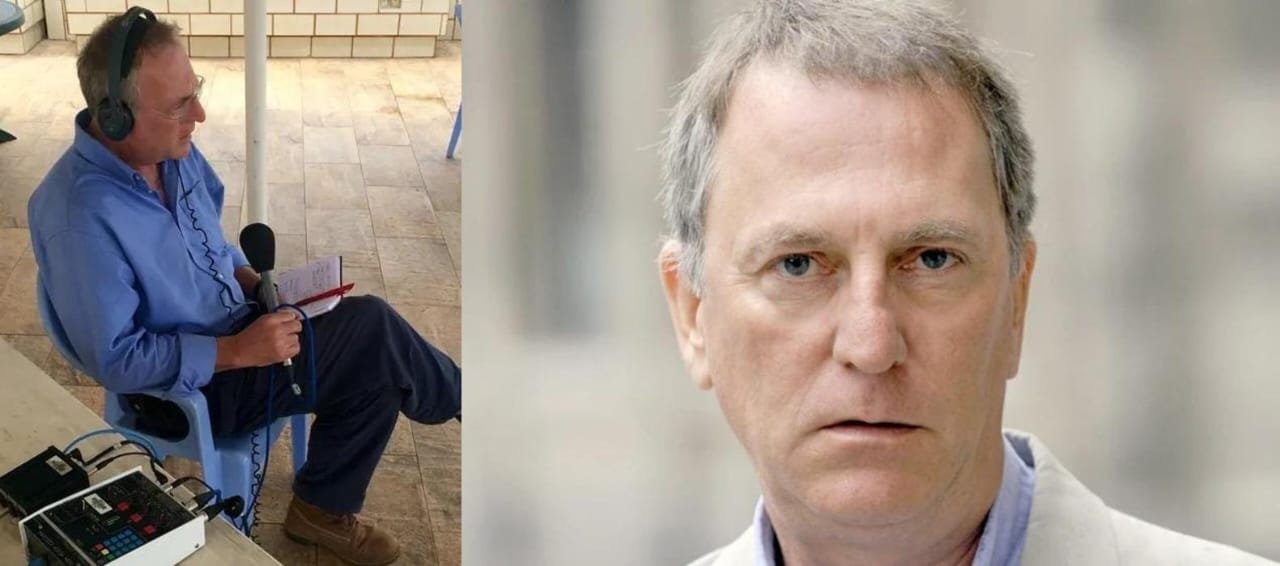

British journalist Mark Doyle is on record as one of the outstanding, but very few, “engendered species” of foreign correspondents who reported on and in Africa, its people, and conflicts from the heart, with understanding and empathy.
Other survivors from the old brigade of news hunters, whom I can easily remember, include Michael Holman, 80, Quentin Peel, 78, Justin Webb, and Patti Waldmeir, all of the London Financial Times. The others are Elizabeth Blunt and Alexander Thompson of the BBC, and Soja Page and Scott Bob of the Voice of America (VOA).
Among the departed in this category was François Xavier-Harispe (Patxi), my boss at the French News Agency (AFP), Lagos Bureau. The list of the past heroes on the domestic (Nigerian) side includes Chief Akin Rotibi and his brother Bayo Rotibi, and Gabriel Ogunsekan of (AFP/Reuters). Chief Rotibi retired as Commercial Manager, News Agency of Nigeria (NAN), and Chief Ogunsekan as Director of the Nigerian Institute of Journalism (NIJ). Also departed are Tunde Fatunde (RFI and Africa No. 1), Oluremi Oyo (NAN/IPIS), later Chief Press Secretary to former President Olusegun Obasanjo and Managing Director of NAN, and Fortunatus Dawodu (RFI).
James Jukwey (Reuters), Toyin Chiahamen and Ade Obisesan, both of AFP, Dulue Mbachu, Paul Okolo and Eniwoke Ibagere (Reuters) belong to the surviving group of successors from the “home brigade.”
I must apologise in advance that these names are by no means exhaustive. But this tribute is to the memory of Mark Doyle, who succumbed to a dreaded “brief illness” on 21 September 2026. We can take solace in the fact that he and his colleagues of the same epoch left a legacy of transformative journalism that shaped public policies and positively impacted lives with their pens, cameras, tape recorders, typewriters, telex machines, and later laptop computers and mobile phones.
The BBC News website is one of my regular news sources. But somehow, I had not consulted the platform before 18h50 GMT on 22 September, when a friend, a retired Nigerian army general, alerted me through a WhatsApp message that our mutual friend, Mark, had passed on. Mark and I had only exchanged WhatsApp messages a few weeks ago, when he indicated that he was planning a trip to Ukraine. So, news about his demise was very devastating and difficult for me to process.
Fighting back fear and feelings of tribulation, I summoned courage and decided to play the sceptic by calling Mark’s telephone number. My worst fear was confirmed. The voice on the other side was that of Mark’s wife, Anna. As we exchanged condolences, her stoic spirit in our collective loss was infectious.
I knew Mark several decades ago from his days as the BBC’s first resident correspondent in Nigeria. We solidified our friendship when he invited me over to his London home in 1992, when I was pursuing postgraduate studies at the University of Cardiff, Wales. Mark picked me up from the train station in his expensive and intimidating BMW motorbike. I met Anna for the first time then. Mark and I used the opportunity of the visit to catch up on our years as journalists in Nigeria – he as the BBC correspondent, and myself – first as Deputy Bureau Chief of AFP and later, Senior Diplomatic Correspondent of NAN.
After living in Africa, Mark joined the BBC in 1986. He later became an East Africa correspondent in 1993 and made his mark covering the Rwandan genocide in 1994. As a West Africa correspondent from 1997 to 2002, Mark reported on Sierra Leone’s civil war and the aftermath of Liberia’s conflict.
We met in Liberia as war correspondents.
There were two categories of foreign correspondents in post-colonial Africa. One was the group that covered events from their hotel rooms and often called themselves “experts on Africa.” After landing in their places of assignment from abroad, they seldom left their hotel rooms. A moniker for this group is “parachute or kamikaze journalists.”
Mark and his ilk belonged to the second category. They reported on Africa with conscience, asked the right questions and were properly guided. For instance, the Financial Times of London dispatched its correspondents to Nigeria for several weeks for its annual surveys. The reports were a reference material on the structure, performance and challenges of the Nigerian economy, with recommendations for improvement.
Mark et al. followed up on developments in Africa, not in a fire-brigade reportage. Before he filed any reports on Nigeria, whether inside or outside the country, Mark would cross-check the veracity of information and facts with his reliable contacts. He did so regularly when I was at NAN and when I became the Bureau Chief of West Africa for the Senegal-based Pan-African News Agency (PANAPRESS) from 1994 to 2000.
Unlike many countries, Nigeria has long been a news hub for professional journalists. There were risks too, especially during the country’s prolonged military rule. Some media houses were shuttered, and censorship took different forms. Following the closure of the Reuters office in Nigeria and the expulsion of its correspondents in February 1976, most foreign media organisations decided to report on Nigeria from outside, mainly from Abidjan, Côte d’Ivoire. The BBC operated the offshore system until Mark blazed the trail as its pioneer resident correspondent in Lagos.
Reuters was eventually allowed back in the country. However, the AFP office at 26 Keffi Street, Ikoyi, during my time, was a mecca of sorts for visiting foreign journalists, including those from the BBC, VOA, the Associated Press, British and American newspapers, and the French and German media organisations.
To round off his tour in Nigeria, Mark hosted a well-attended send-off party at his Ikoyi office/home. I was at NAN then, and used the event as a peg to pen a story about Mark’s illustrious professional career, which he found captivating and decided to frame it as a memento. He proudly showed me the souvenir when I visited him in London in 1992.
I was at the UN World Health Organisation (WHO) in Ouagadougou, Burkina Faso, from 2008 and after I moved to the Economic Community of West African States (ECOWAS) as a Communications consultant in Abuja, the Nigerian capital, in 2011, I met Mark on occasion when we both served as election observers in the region. He worked for the EU Observation Mission.
We kept the pilot light of our personal and professional friendship burning. Our last in-person meeting was in 2025, when we attended a Chatham House event in London.
Mark eats healthy. He brought his breakfast with him when we met at Chatham House. His breakfast was a sandwich with chopped tomato from his garden and water. He bought me breakfast as we discussed and waited for the event to begin.
Tributes have continued to pour in extolling Mark’s virtues as a humane person and a thoroughbred professional.
BBC foreign editor Paul Danahar described Mark as a “legendary figure,” as well as a “brilliant, brave, empathetic reporter.” Andrew Harding, who worked with him, paid tribute to his former colleague in a 2015 article published at Mark’s departure from the BBC after rising to World Affairs correspondent.
Fergal Keane, another prominent BBC correspondent in Africa, recalled their stint in Rwanda in 1994. “He stayed longer than any of us,” Keane said of Mark. “Those who were in that awful place at that awful time will know what Mark Doyle gave for the cause of truth and for the BBC.”
Sir David Richards, who headed British forces that supported ECOWAS’ efforts to stop Sierra Leone’s civil war in 2000, also praised Mark, noting that his reporting “helped convince the UK government of the need for a robust intervention.”
For his coverage of post-war Liberia, Mark received the first prize in the UN Correspondents Association/UN Foundation Awards in 2004. Mark reported on, and in Africa for more than 26 years. “Not just parachuting in for the big stories but living here. Seized by an impulse to question, to understand, to get to the bottom of things,” Harding said.
Danahar narrated how, “Mark himself tells of being ushered unexpectedly to meet African presidents who – having heard him so often on the radio – felt like they knew him as a friend.”
”Africa is changing fast – booming in some places – with Twitter, mobile phones, a glut of information in more and more hands. But this is still a monstrously unequal continent, and there is no substitute for the journalist who knows you don’t find real news online behind a desk,” added Harding.
Mark is survived by Anna, his wife, their two boys and other relatives.
Adieu Mark. Africa and the BBC will certainly miss your professional reportage. I will miss our banter, your frankness and collegiality, especially during our many animated discussions of contemporary issues in the profession and continent you loved.
A Global Affairs Analyst & Consultant on Strategic Governance Communications, Paul Ejime, a War Correspondent, was embedded in ECOMOG during the Liberia and Sierra Leone Civil Wars.