

PRESS RELEASE
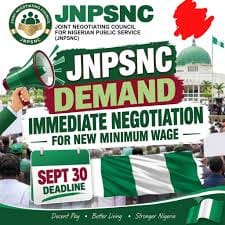
Nigerian public servants under the Joint National Public Service Negotiating Council (JNPSNC) have threatened to begin a three-day warning strike on Friday, 2nd October unless the government reduces the price of petrol to 500 Naira per litre and approves a new minimum wage.
The Naira currently trades at about 1,340 to one US dollar, while petrol (PMS) sells at between 1,300 and 2,500 Naira per litre in Africa’s oil-producing and most populous nation.
Nigeria’s public service employs an estimated three million or more workers across the federal, state and local council levels in a country with an estimated population of 230 million.
The JNPSNC, which has been involved in negotiations with the federal authorities, said in a statement that its “September 30 ultimatum” to the government to address the rising cost of petrol and negotiations for a new national minimum wage “remains sacrosanct.” Nigeria’s current national minimum wage is 70,000 Naira a month.
“The three critical issues requiring urgent attention are as follows: reduction of fuel price to 500 Naira per litre. The Federal Government should take urgent steps to bring down the price of Premium Motor Spirit (PMS) to 500 Naira per litre,” said the statement
“The Federal Government should urgently approve a wage award for Nigerian workers to cushion the effects of the prevailing harsh economic conditions being experienced by workers, their dependants, and vulnerable Nigerians,” the Council affirmed, adding: “It is imperative… that the Independence Day address of the President… (on 1st October) should adequately address these critical issues.
“Consequently, the council states that failure by the Federal Government to take the necessary steps to address these issues on or before 30th September 2026 will leave Nigerian workers with no option but to commence a three-day warning strike, with effect from Friday, 2nd October 2026, to press home their demands,” added the statement.
It recalled that on 21 September, the Council wrote to President Bola Tinubu with three demands, including the commencement of negotiations for a minimum wage of not less than 500,000 Naira per month from 2027, among others.
The Council, however, “expressed displeasure that no visible action had been taken on the demands more than a week after the letter.”
It noted that petrol prices could be reduced through the provision of an intervention fund to address the landing costs of the commodity and support oil and gas operators.
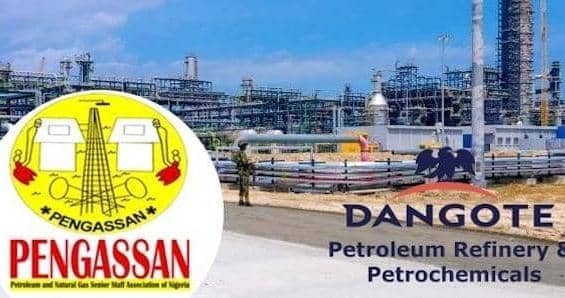
“It is equally important for the Federal Government to ensure the sale of crude oil to the Dangote Refinery and operators of modular refineries at appropriate terms to facilitate increased domestic refining and help bring down the price of petroleum products,” the statement said.
The Council said the current price of PMS, ranging from 1,450 to 2,000 Naira and, in some locations outside major communities and cities, as high as 2,500 Naira per litre, “is unacceptable to Nigerian workers.”
Continuing, the statement said the “Council maintains that the economic hardship occasioned by the high cost of fuel is placing the survival of Nigerian workers, their dependants and the general populace under severe pressure, making it increasingly difficult for (them) to live normal and dignified lives”.
It noted that “urgent action on the demands will further enable public servants to consolidate their loyalty, commitment and productivity within the public service ecosystem.”
Nigeria has four non-operational oil refineries, but was importing refined petroleum products and Nigerians endured perennial petrol shortages until business mogul Aliko Dangote launched his mega-refinery in Lagos two years ago.
The JNPSNC urged the federal government to “urgently establish” a tripartite committee to facilitate negotiations for the new minimum wage.
“The Nigerian workers’ demand for the immediate constitution of the committee is informed by the need to avoid any administrative or procedural delay that could affect the implementation of the new National Minimum Wage once it is eventually negotiated and passed into law by the National Assembly,” the Council added.
Analysts link Nigeria’s hardships to the government’s tough economic measures, including the removal of the oil subsidy in 2023 and the floating of the local currency, the Naira, while critics accuse the government of borrowing for consumption, with officials living extravagantly at the expense of the masses.
But the government insists its austerity measures aim to stabilise the national economy for growth and development.
The JNPSNC comprises eight public sector unions, including the Nigeria Civil Service Union (NCSU), the Medical and Health Workers Union, Association of Senior Civil Servants of Nigeria (ASCSN), and the National Association of Nigerian Nurses and Midwives.
Others are the Amalgamated Union of Public Corporations, Civil Service Technical and Recreational Employees, Nigeria Union of Public Service, Reportorial, Secretarial, Data Processors and Allied Workers, National Union of Printing, Publishing and Paper Products Workers, and the National Union of Agriculture and Allied Employees.##