


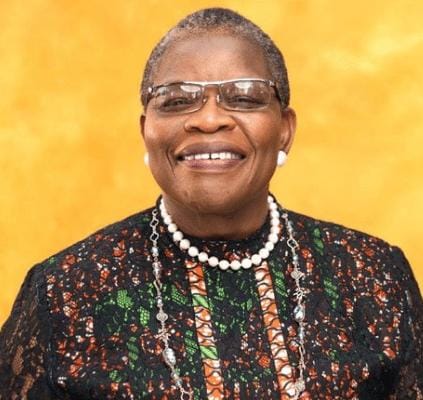

To mark the International Day of the Girl Child 2026, Dr Obiageli “Oby” Ezekwesili, Nigeria’s former Minister of Education, joined the clarion call for an end to child marriage and more investment in girls’ rights over the weekend. Below is her statement:
A girl who learns is a girl who is not a bride
Today (11 October), the world is asked to end child marriage and invest in girls’ rights. I join that call wearing three hats: as a member of the advisory council behind Columbia University’s report Accelerating Efforts to End Child Marriage; as Civil Society Representative on the Steering Committee of the African Union’s Decade of Accelerated Action for the Transformation of Education and Skills Development in Africa (2025-2034); and as the leader of Human Capital Africa (HCA), an organisation that has spent years arguing that Africa’s human capital crisis begins in the early-grade classroom.
The numbers are clear.
UNICEF’s 2026 estimates show that about one in five girls worldwide is married before 18. That adds up to roughly 650 million women and girls alive today who were married as children. More than 12 million girls are still married each year, about one every three seconds, and sub-Saharan Africa has the highest prevalence at 31 per cent.
In Nigeria, 23.6 million women and girls were married before 18, the largest number in West and Central Africa. In parts of the North, the situation is a national emergency: in Jigawa, 78 per cent of women aged 20-49 were first married before 18, and 63 per cent of women left school to marry.
The cost of inaction is high.
Our Columbia report includes a new analysis by the Centre for Global Development. It estimates losses of up to $175 billion a year, or almost $2.5 trillion by 2040, from lost productivity and higher health risks caused by child marriage. The report also warns that aid cuts, weakening global commitment to women’s rights, and rising conflict could slow or reverse progress. Child marriage is not a side issue in development. It drains a nation’s human capital directly.
Progress is possible.
An estimated 68 million child marriages have been averted over the past 25 years, through girls’ education, legal reform and social protection. The evidence on what works is strong:
- Each year of secondary education lowers a girl’s chance of marrying before 18 by five percentage points or more.
- In Niger, when the government removed the direct costs of middle school for rural girls, each additional year in secondary school was associated with a 19 percentage point lower probability of marriage.
- If every African girl completed secondary education, child marriage could be almost eliminated.
Where HCA’s mission and this campaign meet.
A girl cannot stay in secondary school if she never learned to read. Today, 89 per cent of children in sub-Saharan Africa are in learning poverty, unable to read and understand a simple text by age ten. A girl who cannot read by ten falls behind, then drops out. Once she is out of school, she is at the greatest risk of marriage. That is why we say schooling is not learning. Foundational literacy and numeracy are the first and cheapest protection a girl has.
At the Columbia launch, I said that community programmes and advocacy are not enough on their own. Governments must lead. On this Day of the Girl, Human Capital Africa calls on African governments to:
- Make foundational learning a girl-protection policy. Every girl should be reading with comprehension by age ten, using proven methods such as structured pedagogy and Teaching at the Right Level.
- Guarantee the move into secondary school. Remove fees, uniform and transport costs for girls, especially in rural communities with high rates of child marriage.
- Enforce 18 as the minimum age of marriage in law and in practice, in every state and every community, with traditional and religious leaders as partners.
- Fund this domestically. As foreign aid shrinks, African budgets and African philanthropy must take over.
- Measure and publish. Track girls’ learning, their transition to secondary school, and child marriage rates in national accountability systems. The AU Decade of Education gives Africa ten years and a continental mandate. As a member of its Steering Committee, I will press for girls’ learning and retention to be at the centre of how the Decade’s success is measured. A Decade that does not end child marriage will not have transformed African education.
The Columbia report sets a realistic target: cutting child marriage prevalence from one in five to one in seven within five years. Africa can lead the way to that target, but only if we treat every girl’s classroom as the place where her childhood is protected.
Every girl child should be a student, not a bride. She should learn, then lead.
Founder, Human Capital Africa, Dr Obiageli “Oby” Ezekwesili was former Nigeria’s Minister of Education and Vice President for the Africa Region, World Bank.