



Unconstitutional changes of government have wrought havoc on participatory democracy in Africa, including a resurgence of military rule, authoritarianism and dictatorships, poor leadership and bad governance, especially in West Africa.
This is why the ongoing process to amend the Fourth Republic Constitution of Ghana, the first sub-Saharan African country to gain political independence on March 6 1957, has generated much interest.
The late Flt.-Lt. John Jerry Rawlings oversaw the process that produced Ghana’s 1992 Fourth Republic Constitution, which he used for the country’s transition from military rule to multi-party democracy 34 years ago.
Since then, Ghana’s two dominant political parties, the National Democratic Congress (NDC) and the New Patriotic Party (NPP), have alternated power peacefully on eight occasions, a record in the politically restive West Africa with the uncomplimentary moniker of a “coup-belt”. Incidentally, Ghana had its own fair share of military coups, too (five) before 1992!
Calls for review of the 1992 constitution gained momentum during the administration of the 10th President, John Kufuor, of the NPP, nicknamed the “Gentle Giant”. One recurring recommendation is extending the presidential term. Even out of office, Kufuor, who served the two terms allowed by the 1992 constitution from 2001-2009, has suggested a presidential tenure extension of five to eight years.
John Attah-Mills of the NDC succeeded Kufuor in January 2009 until the former’s death three years and 199 days later. His deputy, John Mahama, completed his remaining tenure and went on to win the presidential vote in 2012 but lost his re-election bid in 2016 to NPP’s Nana Akufo-Addo, who also served for two terms. Mahama staged a remarkable comeback and defeated another NPP candidate in the 2024 election.
Unlike the Benin Constitution, which categorically states that no person shall serve as president for more than two terms in his/her lifetime, the constitutions of most African countries are vague on this crucial issue, except for Cabo Verde, whose constitution prohibits two consecutive presidential terms.
African political leaders have exploited this loophole to alter their national constitutions and begin “new terms”, claiming that the mandates under old constitutions do not count.
In the ECOWAS region, President Alassane Ouattara of Côte d’Ivoire used this controversial method to change his country’s constitution in 2016 and has remained in power, serving a fourth term.
Alpha Condé of Guinea followed Ouattara’s example by ordering a referendum and presidential election in 2020 during the COVID-19 pandemic period. This resulted in the deaths of at least three top government officials, including the chairman of the national election commission, Mamdou Salif Kebe. Condé was toppled in the September 2021 coup led by Col. Mamady Doumbouya, who later promoted himself to a General.
Doumbouya changed the constitution, organised elections boycotted by the opposition, and claimed victory in December 2025, in clear violation of the ECOWAS 2001 Supplementary Protocol on Democracy and Good Governance, which prescribes “zero-tolerance” for unconstitutional change of government, and specifically stated that a coup maker should not benefit from such an illegal action.
But Doumbouya is not alone. The presidents of Togo and Benin have also carried out controversial amendments to their countries’ constitutions, resulting in presidential tenure extension in Benin from five to seven years, and changes to how a president is elected in Togo, among other alterations. Ex-Benin President Patrice Talon was elected Senate President on 6 August 2026, three months after he left office and having survived a coup attempt in December 2025, which Nigeria helped to foil.
Former Senegalese President Macky Sall, now engrossed in a desperate campaign for the UN Secretary-General’s post, had to abandon his controversial third-term bid, but not before it had resulted in the deaths of dozens of citizens involved in anti-government protests.
Military juntas in Mali, Niger and Burkina Faso, which pulled their countries out of ECOWAS following coups to form the Alliance of Sahel States, AES, and Guinea-Bissau, the fourth regional country ruled by the army after a self-coup by its former President Umoru Sissico Embaló, are all ruling by decrees and tinkering with their national constitutions.
The coup epidemic is seen as a direct consequence of bad governance and an anti-democratic disposition among political leaders. ECOWAS finds itself in a quandary, with contagion effects felt in other African countries such as Gabon, Chad and Sudan.
However, Ghana appears to have chosen a more measured and strategic approach to its constitutional reform. President Attah-Mills set up a Constitutional Review Committee (CRC) in 2010, which made recommendations that resulted in a Government White Paper. His NPP successor, Akufo-Addo, did not follow through.
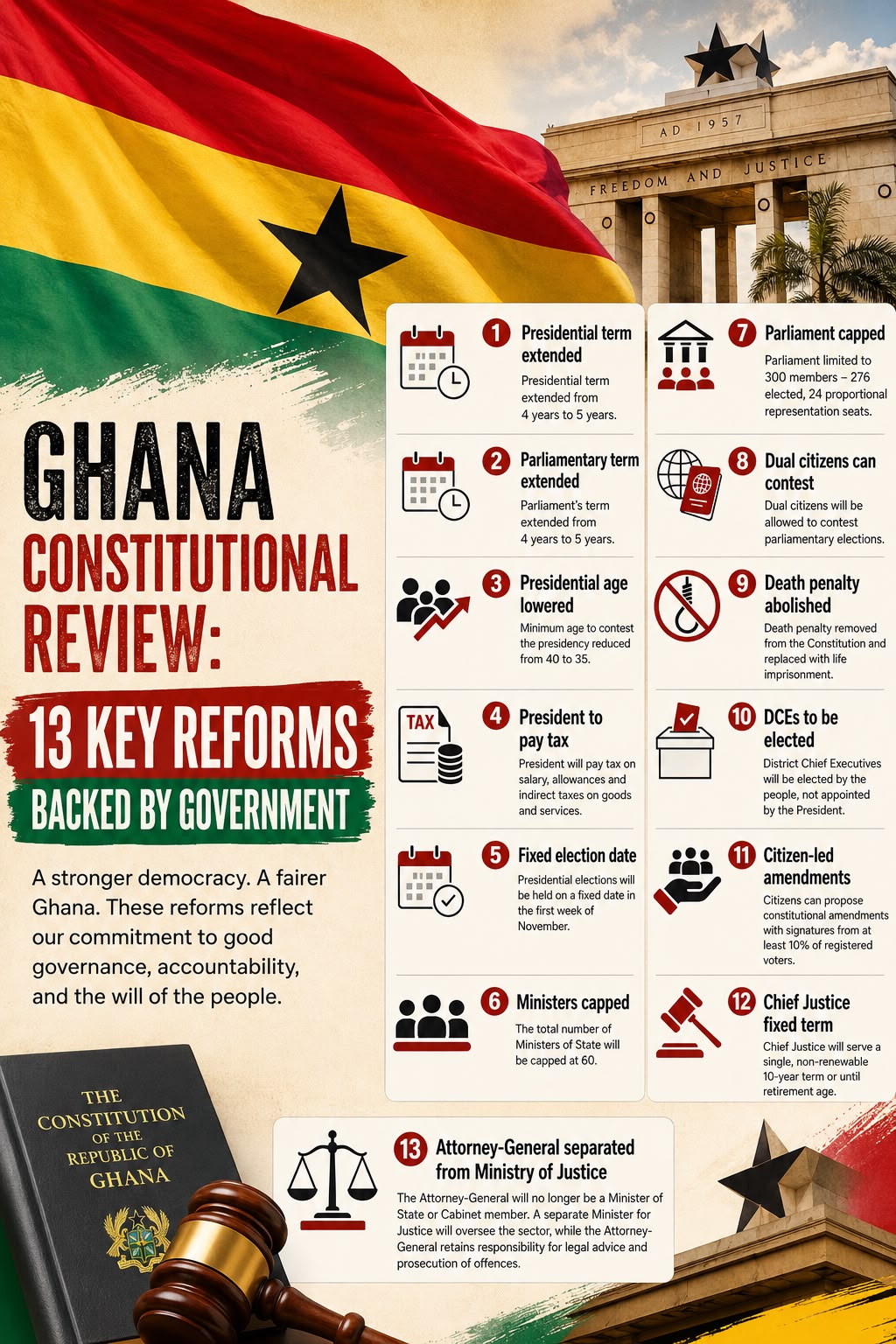
President Mahama, during his second coming, appointed another CRC, which submitted recommendations in December 2025. On 30 July 2026, the Attorney-General and Minister for Justice, Dominic Ayine, announced the government’s position on the CRC’s report. Apart from the extension of the presidential mandate, other key recommendations accepted by the Mahama government include:
Reducing the minimum age of the president from 40 to 35, extending the parliamentary term limit from four to five years, excluding MPs from being appointed Ministers, capping parliamentary seats at 300, with 276 elected and 24 by proportional representation, with the president now required to pay income tax on salary and allowances, and indirect taxes on goods and services.
Others are capping the number of Ministers of State to 60, fixing the national election date in the first week of November, the Attorney-General will no longer be a Minister of State or cabinet member, a Minister of Justice will oversee the sector, while the Attorney-General retains the responsibility for legal advice and prosecution of offences.
The government White Paper also recommended that the Chief Justice should serve a single non-renewable 10-year term or until retirement age, abolition of the death penalty, to be replaced by life imprisonment, candidates with dual citizenship can contest parliamentary elections, District Chief Executives should be elected by the people and not appointed by the president, and citizens can propose amendments to the constitution with 10% signatures from registered voters.
These issues have been subjected to wide consultations, public debates, and parliamentary hearings. Some of them will still be sorted out by parliament, while the key amendments will be voted on in a national referendum, requiring a minimum of 70% of votes and voter turnout of at least 35% to pass.
Minister Ayine said if passed, the changes would “improve governance.” Defending presidential term extension, he said: “The early months of every administration are consumed by transition matters, and the final year is largely consumed by elections.”
However, Prof Kwasi Prempeh, Chairman of the CRC, feels that the government’s position on the recommendations ought to have come as “input” instead of “output” of the Committee’s report. “What marks out a constitutional process is the degree of public participation that it enjoys.”
Other commentators, including Richard Mawuli Amegatse, a 2028 presidential aspirant, also disagree with the government’s paper on some issues. For instance, he said: “If you hire a man and he performs poorly in four days, do you add a fifth day to justify his poor performance, or do you sack him on the fifth day? A second term is a reward for a good first term. Increasing the years from four years to five years does not solve the underlying incompetence; it only gives incompetence more time to do more damage.”
Whether the process will still be subjected to further public debate/contributions is unclear. But despite his avowal not to seek re-election in 2028, conspiracy theorists are on overdrive, alleging that Mahama will likely emulate Ouattara and others in going for a third term after the constitutional review.
In politics, nothing is taken for granted. But for now, there is no evidence to suggest that Mahama, given his leadership track record, will go back on his word.
Even so, Ghana’s constitutional amendment process seems more attuned to participatory democracy compared to other examples that have unleashed political instability. At least, the two dominant political parties are involved in it.
Ejime is a Global Affairs Analyst and Consultant on Peace & Security and Governance Communication